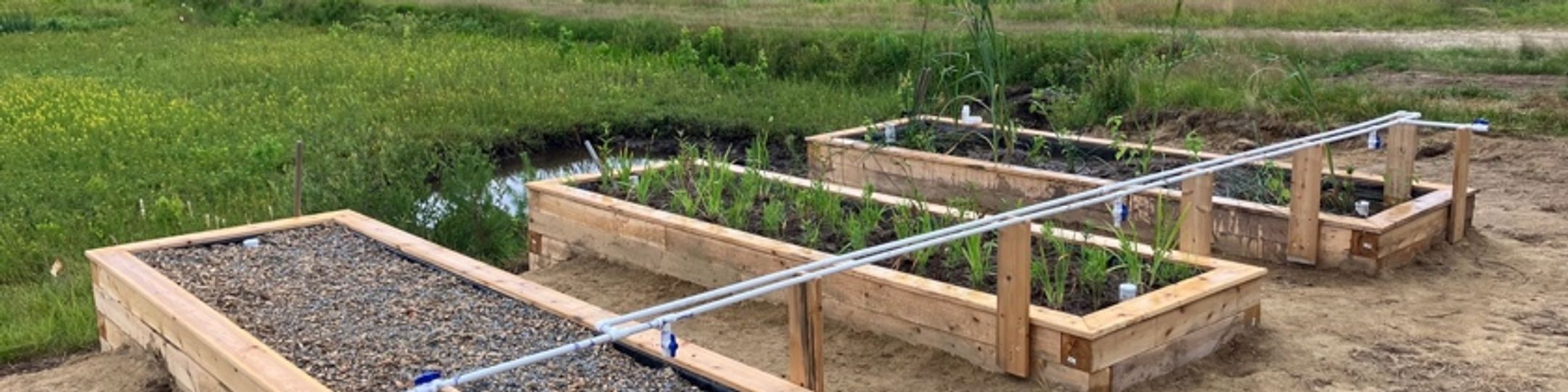
Marstons Mills Cranberry Bog Eco-Restoration Project
Designing a water quality monitoring program for Marstons Mills CSA
On October 28, Scott Horsley, Jim Limbrunner and Adrian Wiegman spoke with Casey Kennedy about automated nitrogen sampling and reliable flow measurements at the CSA outlets. The group discussed sample preservation, vegetation around sampler intakes, and how downstream obstructions or changing cell water levels could affect the relationship between water level and flow.
Casey described the Tidmarsh approach: collect four subsamples at six-hour intervals for a daily total nitrogen composite, supported by weekly grab samples as an independent check (Kennedy et al., 2026). He recommended confirming preservation with the laboratory, collecting separate grab samples for individual nitrogen forms, and checking intakes for vegetation during field visits. Neill et al. (2017) provides another cranberry-farm sampling example, using ISCO 6712 samplers with four-day composites.
For pipe outlets, Casey suggested evaluating a Teledyne ISCO 2150 acoustic Doppler meter, which measures both depth and velocity, and maintaining an independent flow check where practical. Jim recommended comparing flow measurements at the existing CSA outlet monitoring location with measurements at a more uniform downstream cross section before deciding where to monitor flow. The group also discussed the Massachusetts Estuaries Project QAPP as a starting point for documenting sampling and quality-assurance procedures (Howes & Samimy, 2005).
On November 12, Scott Horsley, Leaden Langley, Zenas Crocker and Adrian Wiegman met with Tim McCobb to discuss continuous nitrate measurements, groundwater entering and leaving the newly excavated pond in Cell C, and representative sampling at the subsurface-flow cell outlet.
Tim suggested considering SUNA an a lower cost alternative to Hach for nitrate instruments. Tim also cautioned that nitrate sensors can be challenging to operate, particularly managing power, retrieving data, maintaining the instruments and checking readings against laboratory samples. He raised weekly grab sampling as an option at additional locations where continuous measurements may offer limited benefit. Pellerin et al. (2013) provides guidance on instrument selection, deployment, maintenance and data quality.
At the pond, the group discussed distinguishing shallow lateral flow through sand from deeper flow through or below peat. Tim shared a pond-bottom multiport sampling example from a phosphate-removal study, while noting the difficulty of installing such equipment in an established pond (McCobb et al., 2009). Ultimately Tim recommended starting with temporary push-point samplers to map nitrate concentrations and identify likely groundwater inflows before selecting permanent sampling locations.
For the subsurface-flow cell, the group discussed a horizontal collection screen or an open lateral ditch as possible ways to obtain representative outlet samples. Decisions on outlet structures remain open as of this post.
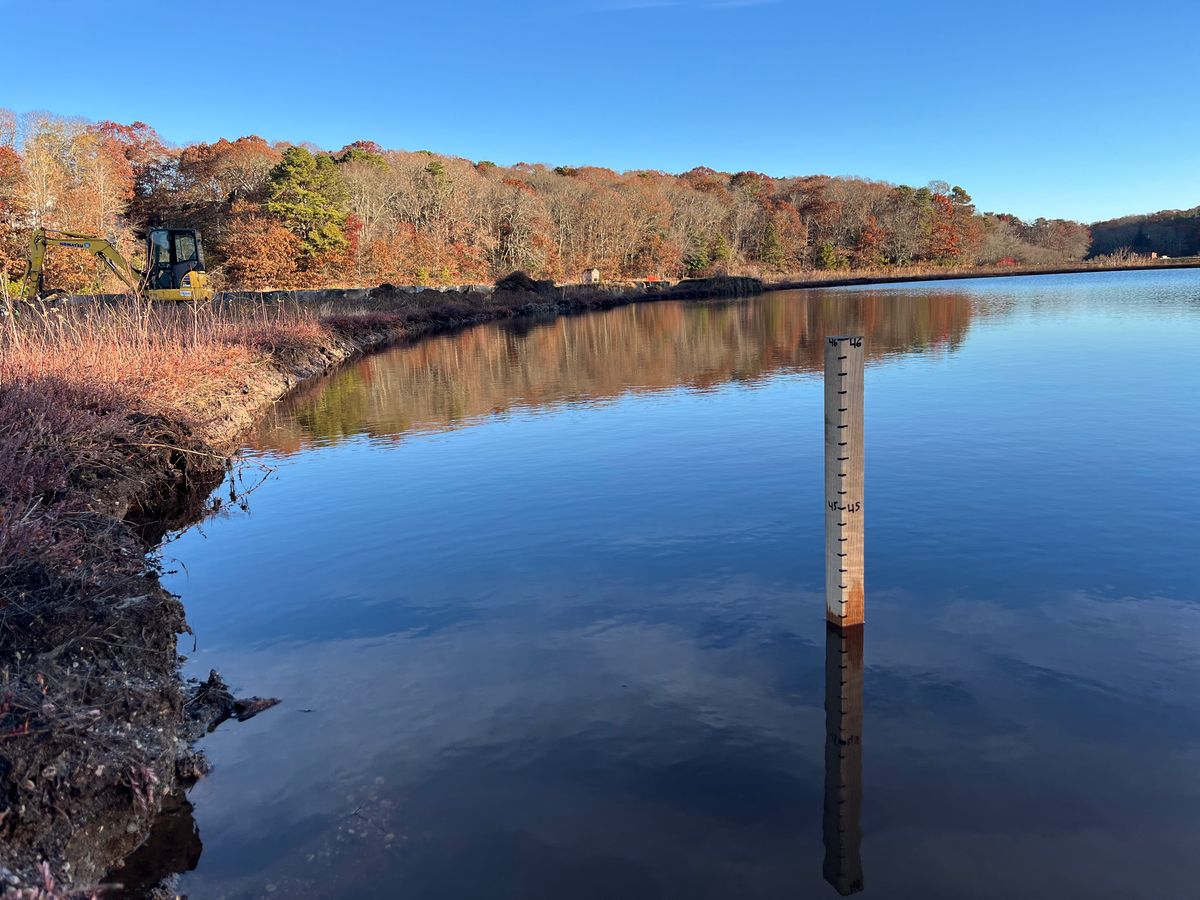
Grade stake at newly excavated pond at Marston Mills CSA on November 11, 2026 (Credit: A. Wiegman)
Howes, B., & Samimy, R. (2005). The DEP/SMAST Massachusetts Estuaries Project: Year three (final)—QAPP revisions, round 4 embayment prioritization. University of Massachusetts Dartmouth, School for Marine Science and Technology.
Kennedy, C. D. (2015). Hydrologic and nutrient response of groundwater to flooding of cranberry farms in southeastern Massachusetts, USA. Journal of Hydrology, 525, 441–449. https://doi.org/10.1016/j.jhydrol.2015.02.038
Kennedy, C. D., Wiegman, A., Welsh, M., Buda, A., & Millar, D. (2026). Ecological restoration of a cultivated wetland to enhance nitrogen retention in a rapidly developing watershed. Water Resources Research, 62, e2025WR041361. https://doi.org/10.1029/2025WR041361
McCobb, T. D., LeBlanc, D. R., & Massey, A. J. (2009). Monitoring the removal of phosphate from ground water discharging through a pond-bottom permeable reactive barrier. Groundwater Monitoring & Remediation, 29(2), 43–55. https://doi.org/10.1111/j.1745-6592.2009.01235.x
Neill, C., Scott, L., Jakuba, R., Kennedy, C., & DeMoranville, C. (2017). Nutrient balances in southeastern Massachusetts cranberry bogs: Final report. Buzzards Bay Coalition.
Pellerin, B. A., Bergamaschi, B. A., Downing, B. D., Saraceno, J. F., Garrett, J. D., & Olsen, L. D. (2013). Optical techniques for the determination of nitrate in environmental waters: Guidelines for instrument selection, operation, deployment, maintenance, quality assurance, and data reporting (Techniques and Methods 1–D5). U.S. Geological Survey. https://doi.org/10.3133/tm1D5
November 18, 2026
