
Volunteer River Herring Monitoring at Beaver Dam Brook and Manomet Brook
Looking back at 2026 and thinking ahead to 2027
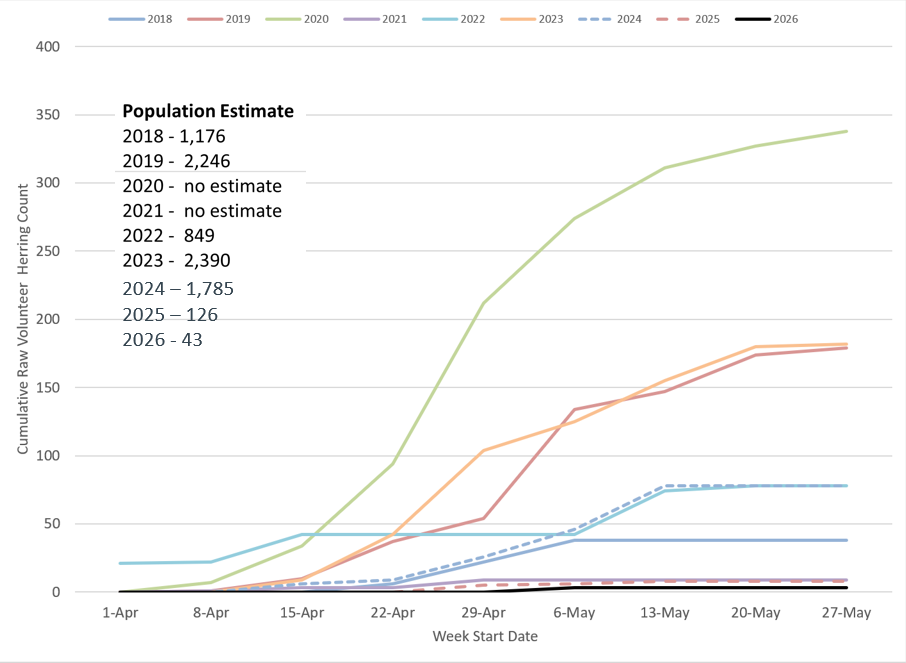
Volunteer counts have been occurring at Beaver Dam Brook since 2018, and while the site had a peak estimated population of ~2,390 (raw count 182) in 2023, the numbers have been decreasing since then to an all-time low this year of an estimated population of 43 +/- 55, with only 3 fish counted by volunteers. That raises the question of *why* we are seeing these patterns. Here are some ideas:
1) Volunteer coverage: A high standard error on population estimates like the one above indicates that volunteer coverage is not quite supporting the statistics needed for a precise estimate. The ideal scenario is one where each of the three time blocks in the day has three counts, but even ensuring we have counts each day is crucial to understanding what those counts mean, population-wise. After holding steady at around 330-340 counts per season (an average of 5.5 counts per day) in 2021-2023, the number of counts has declined to about half that in 2026 (163 counts). A low count number is a self-fulfilling problem - if volunteers don't see fish, they potentially get discouraged, count less often, and potentially miss fish. The opposite is also true - when fish are more abundant, there is more incentive to show up. This is why we emphasize the importance of zeros in our data. They help clarify whether there really are fewer fish or if they just aren't being counted.
2) Timing of the run: In many herring runs across the state, there is a pattern of more fish running at dawn and dusk than in the middle of the day. Our counts follow the standard protocol of 7 am to 7 pm, and fish migrating before 7 am or after 7 pm may be missed. This could be resolved by a camera system - one was used during COVID to moderate success.
3) Fish passage impediments: The upstream section of Beaver Dam Brook downstream of Bartlett Road has quite a lot of silt and vegetation growth, there is a new culvert at Beaver Dam Brook that may have some passage problems, and upstream of Bartlett Road to Fresh Pond is also somewhat overgrown. Fresh Pond has a natural outlet and doesn't always flow strongly. We know that fish have been seen in Madar Pond farther downstream on the sanctuary, and perhaps some are spawning there. We also know from MassDMF and MIT Sea Grant studies that herring are making it to Fresh Pond and spawning there. The latter is likely happening during periods of higher flow, which would also allow juvenile fish to run downstream in the fall. We are working on evaluating the potential for small passage improvements.
4) Herring year classes: Juvenile river herring that return to the sea come back to fresh water after 4 years or so. Thus far, the years of 2021 and 2025 have been very low (single digit raw counts) and the years of 2019 and 2023 have had the highest population estimates in the 9 years of the count. While there is some noise in the data and the 4-year return period hasn't occurred too many times, there's some possibility that 2026 was another low year (reflected by a moderately low count in 2022). This might bode well for 2027, which would be a 4 year return period for our highest counts.
November 24, 2026
