Hinckleys Pond Herring River Headwaters Eco-Restoration
Overview
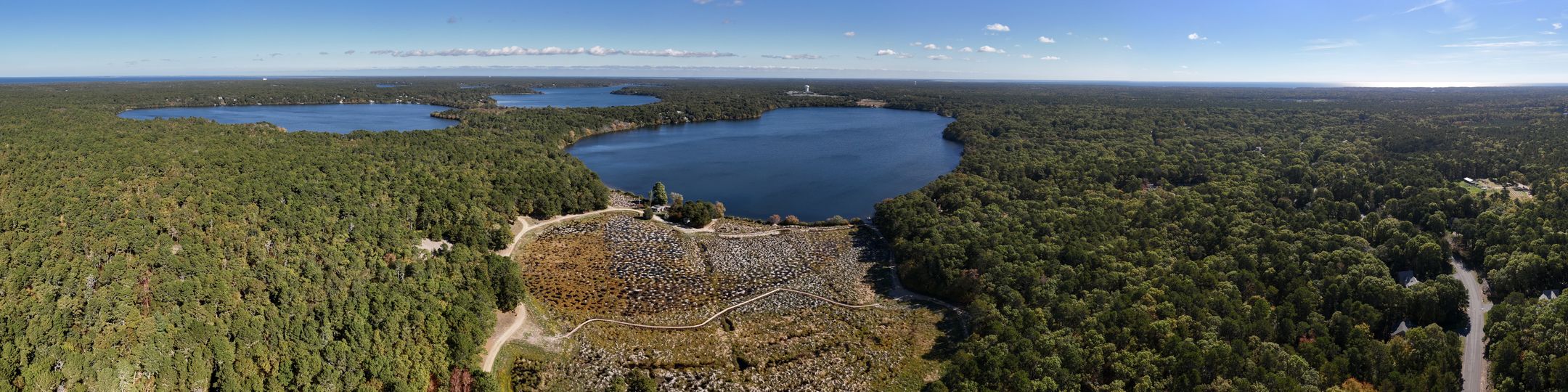
The Hinckleys Pond – Herring River Headwaters Eco-Restoration Project restored two retired cranberry bogs at the headwaters of the Herring River estuary in Harwich, Massachusetts. The project included Jenkins Bog (retired 2020) on the east side of Hinckleys Pond and Warner Bog (retired 2021) on the west side of the pond.
The restoration rewilded approximately 30 acres of retired cranberry bogs, restored pond-shore wetland habitat, and improved public access to the Hinckleys Pond – Herring River Headwaters Preserve. The project also created an all-persons accessible trail connection and pond overlook so visitors could experience the restored landscape.
Hinckleys Pond provides river herring spawning habitat and is connected to additional spawning habitat upstream in Long Pond and Seymour Pond. By restoring former bog wetlands near the pond and at the headwaters of the Herring River estuary, the project improved freshwater wetland habitat, supported native vegetation and wildlife, and contributed to long-term water-quality and habitat benefits.
Timeline
- 2021: Harwich Conservation Trust retained Inter-Fluve for data collection, restoration design, and permitting.
- 2024: Final design and permitting were completed.
- Late 2024: Construction contractor selection was completed.
- March 2025: Restoration construction began.
- June 2025: Earthwork in the bogs was completed.
- September 2025: Trail and related infrastructure work was completed.
- 2025: Year 1 post-restoration vegetation, water-level, and photo monitoring was completed.
Practices
The restoration converted former cranberry bog surfaces back toward native freshwater wetland habitat. Restoration practices included:
- sand removal in selected treatment areas;
- creation of wetland microtopography;
- restoration of pond-shore habitat;
- native plant establishment;
- removal or modification of former cranberry bog infrastructure;
- creation of public access features, including an All Persons Trail and pond overlook;
- and post-restoration monitoring of vegetation, water levels, and fixed photo stations.
The project included areas where sand was removed and microtopography was created, as well as areas where microtopography was created without sand removal. This provided an opportunity to evaluate how different restoration treatments influenced vegetation recovery and wetland development over time.
Partners
The project was led by Harwich Conservation Trust in partnership with the Brown family, Association to Preserve Cape Cod, Inter-Fluve, SumCo Eco Contracting, and other public and private partners.
- Project funding and support included contributions from Harwich Conservation Trust donors, the Brown family, the U.S. Environmental Protection Agency Southeast New England Program, the EPA National Estuary Program Coastal Watershed Grant through Restore America’s Estuaries, the Massachusetts Department of Conservation and Recreation MassTrails program, private foundation funding through APCC, and NOAA Restoration Center funding.
Recent Updates