Living Observatory Sensor Network
The Arm
In the early days of the Tidmarsh sensor project, we had not yet built out our own network and were still figuring out internet access. But thanks to the help of a very generous neighbor abutting "The Arm," one of the impounded reservoirs at the north end of Tidmarsh, we were able to install equipment in his garage to start experimenting with audio streaming at Tidmarsh.
The setup was conceived as a large octophonic arrangement: four microphones spaced about 100 feet apart and four corresponding hydrophones underneath in the water.
We tried to use off-the-shelf hardware where we could (the processing was handled by a Mac Mini with a standard XLR microphone interface) but most studio microphones are not designed to be left out in the rain and elements for long periods of time. Our microphones and hydrophones were custom designs.
The four microphones were based on an experimental design I'd been playing with in an attempt to make a very compact omnidirectional microphone by stuffing an electret capsule and buffer electronics inside the back shell of a standard XLR connector. The opening where the cable would usually come out of the connector acted as the port for sound to enter the capsule.
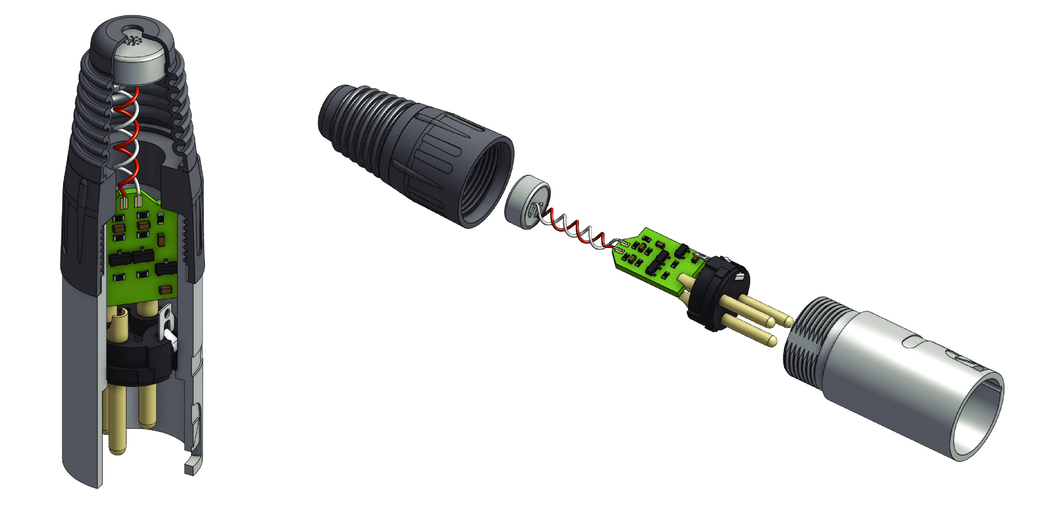
Since the front of an electret capsule is sealed off by a membrane, it is relatively resistant to moisture as long as it is not directly submerged. The capsule was affixed in place with epoxy poured over its backside to further limit moisture ingress into the back shell of the connector.
The circuit is a variation of a common arrangement in low-cost transformerless microphones, using a pair of transistors to create a balanced signal to send over the XLR connector and a resistor/zener diode arrangement to regulate the 48V phantom power supply down to a suitable bias voltage for the FET built into the electret capsule.
The sound quality from this design was excellent, and the microphones lasted for several months in the rain—though moisture did eventually work its way in to the electronics. I made another revision using Neutrik X-HD XLR connectors (which are IP65 water resistant) that lasted longer.
Our hydrophones were also an experimental design that we could assemble from materials in the Media Lab shop. The enclosure consisted of two halves of acrylic with a pocket machined inside, held together by an array of screws and sealed with an O-ring. The pickup was a piezo disc epoxied to one half of the enclosure. The signal was buffered and balanced with a simple JFET circuit, powered by 48V phantom power.
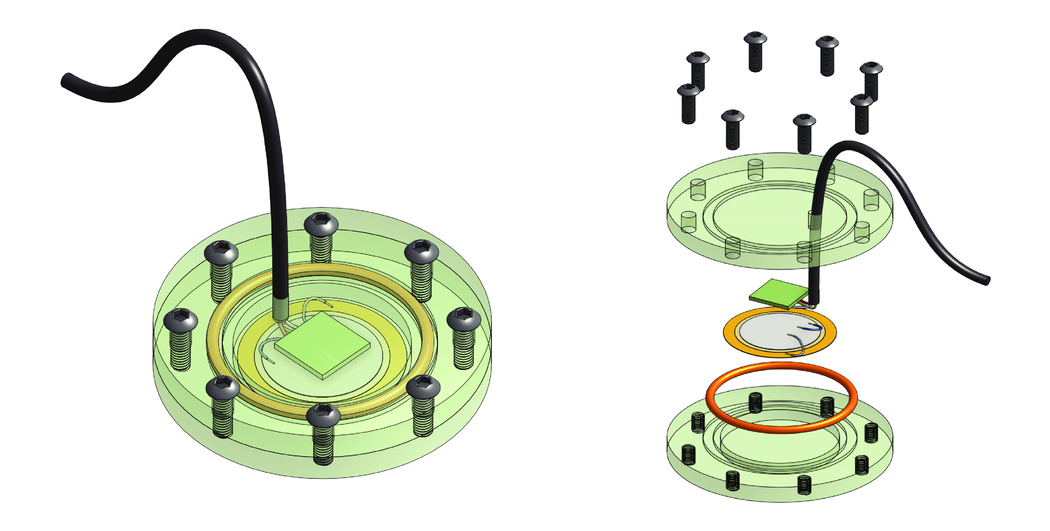
This was far from an ideal hydrophone design (the impedance match between the piezo, acrylic, and the water was not great and the simple epoxy seal around the cable did not withstand the test of time) but they did pick up some underwater sound. Initial tests putting the hydrophone in a glass of soda water sounded amazing.
At the Arm, we learned how challenging our quest for a good hydrophone would be. For our initial deployment, we found that the sound of the Arm under the water just wasn't very interesting compared to the rich and complex sonic environment captured by the microphones. We also discovered that anything in the water has a strong tendency to pick up 60Hz hum, likely due to nearby high-tension power lines that run directly over connected bodies of water.
The microphones, hydrophones, and streaming hardware were installed at the Arm in early 2013.

The timeline of the audio installation at the Arm coincided with an experimental art festival at the MIT Media Lab, tentatively titled The Other Festival. To enable visitors to experience the sounds of Tidmarsh, we temporarily installed a listening space by blocking off a section of our lab with black curtains and bringing soil, stumps, and plants from Tidmarsh. Eight speakers at the corners of the space were set up as a first-order ambisonic playback system, and used ambisonic panners to be able to place the audio from the microphones and hydrophones within the sonic space.
The system ran for several weeks piping live audio from Tidmarsh into the listening space.