
Living Observatory Sensor Network
Technologies for Future Deployments

Photos and video are some of the most concrete ways of looking at the current state of a restoration and how it has changed over time.
Permanently installed network cameras with a high bandwidth connection can provide real-time views of a location, which can be streamed live to the public. With the right infrastructure, timelapse frames and motion-triggered wildlife clips can also be automatically recorded and archived.
This is the most expensive and resource-intensive form of imagery deployment, requiring an installation with a sufficient power source (large solar panel or wired), fast network connection, and infrastructure for streaming and storage. A typical internet connection can support a limited number of camera uplinks. The real-time views can be quite compelling but the implementation cost means that live camera sites should be chosen carefully.
Camera traps have become very popular in the wildlife conservation community. These range from relatively inexpensive off-the-shelf trail cams to custom triggering rigs for high-end digital cameras, capturing both high resolution still images and video clips in response to motion detection, sound, or a time schedule.
A good camera trap setup can capture high quality clips of wildlife activity at much lower cost and with significantly less power and network infrastructure, but requires periodic visits (weekly to monthly) to collect/change memory cards and replace batteries. If this routine is maintained over the course of a restoration, the resulting archive of clips can show the arc of change.
Similar setups (both off-the-shelf and custom) exist for collecting timelapse footage, and a camera situated to capture before, during, and after a restoration project can be a good tool for capturing macro-scale site transformation.
Even without any installed infrastructure, photos collected over time can also capture how a site changes. Photo monitoring can be crowdsourced, such as installing a placard with a QR code that encourages visitors to take and submit a photo with their phone from a particular vantage point.
The Living Observatory community data platform has a location-tagged photo database that can be used for collecting and navigating through such a photo monitoring log. This could be extended to allow photo submissions from the public (likely with some sort of review process).
Aerial imagery can be an excellent tool for seeing how a site changes over the course of a restoration. This can be sourced from commercial datasets (such as the imagery used on Google Maps), governmental sources (such as USGS NAIP), but performing our own drone flights can yield much higher resolution imagery at strategic times. Flights before, during, and after a restoration can show critical parts of the trajectory, and infrared and thermal imagery can show vegetation coverage and water flow.
Visualization tools for exploring drone imagery datasets are on the roadmap for the Living Observatory data platform.
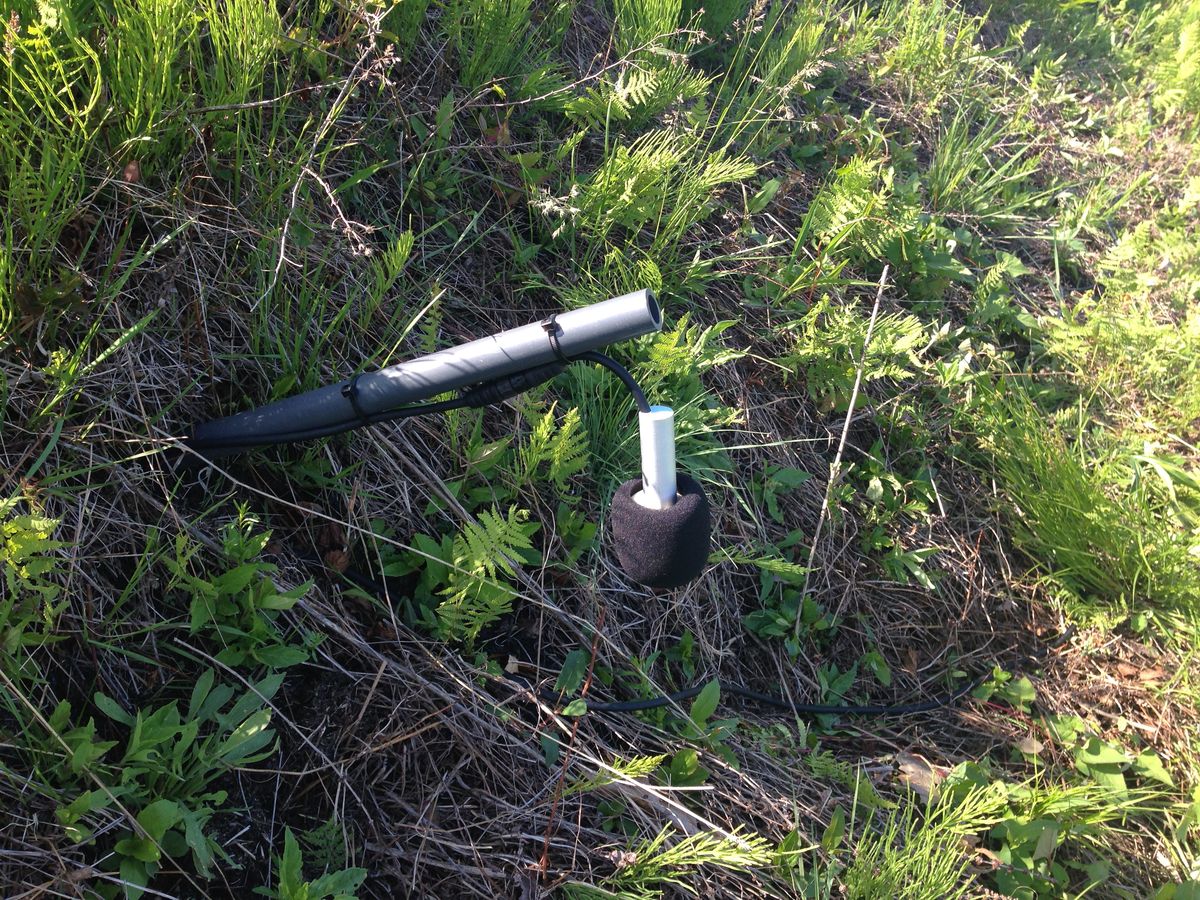
Audio can provide detailed insights into activity and health of a site. Almost everything makes a sound, from the vocalizations of birds and insects to the rustling of foliage in the wind.
Even short representative samples of audio can tell a story—5 to 10 minutes of each season of each year can capture both seasonal and long-term changes.
Similar to video, audio can be captured from a fixed installation and streamed live to the internet. Live audio can be a compelling way to connect with the public—almost everyone can enjoy listening to the sounds of nature.
Audio is less resource-intensive than video, but still requires some infrastructure in the form of a consistent internet connection and enough power to support it. Bandwidth and storage costs are much lower. It is feasible to record and store audio continuously over many years from a fixed streaming installation.
It is important to consider privacy when choosing microphone locations; they should be sited far from trails and publicly accessible areas to avoid inadvertently picking up conversations.
Audio can also be captured by standalone recorders, such as the AudioMoth and Song Meter devices that can record hundreds of hours of audio between visits to change batteries and memory cards. These types of devices can allow capturing audio without any additional infrastructure, and can be a good tool for supplementing live/continuous audio in additional locations or during times when permanently installed infrastructure is infeasible (such as during the construction phase). Audio gathered from recorders could be shared through the Living Observatory data platform.
Low-power environmental sensor devices can record a variety of metrics, both for baseline context (temperature and humidity across the site, for example) or more targeted to test hypotheses and monitor progress.
While our network deployment at Tidmarsh required a lot of custom infrastructure at the time, modern technologies such as off-the-shelf LoRaWAN to cellular gateways have greatly simplified the infrastructure required to stream and record live sensor data over the internet.
Monitoring of soil moisture is currently of particular interest at several Living Observatory sites. In collaboration with the MIT Media Lab's Responsive Environments Group, we are developing a new low-power node to measure soil moisture at multiple depths. We expect to have many of these nodes available for deployment within the next year.
We still have some inventory of the second-generation Tidmarsh sensor nodes, which monitor temperature, humidity, atmospheric pressure, ambient light, ultraviolet radiation, and expansion with external sensors. These have an internal expansion slot where a LoRaWAN radio could be fitted to work with modern gateway infrastructure.
Author
