
Potential Nitrogen Removal by Restoring Wetlands on Retired Cranberry Bogs
New publication related to nitrogen retention
By
Glorianna Davenport
on September 15, 2026
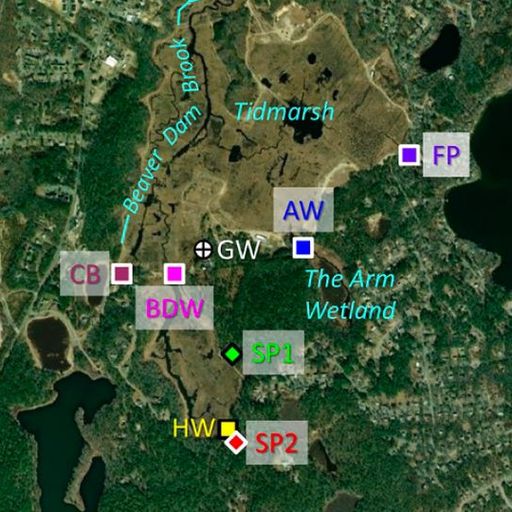
For much of the coastal United States, water quality continues to worsen due to excess nitrogen (N) from agricultural production and urban development. Restoration of freshwater wetlands, especially those connected to streams (i.e., fluvial wetlands), is a promising management option for curtailing watershed inputs of N to coastal embayments, with regional models assuming 77% retention of N by natural wetlands. In this study, we combine modeling, field measurements, and mass-balance analysis to quantify N inputs and retention in a 56-ha, 7-year-old restored fluvial wetland in southeastern Massachusetts, United States. Rapid watershed land-use change, including development of ~30% of forested land between 2001 and 2019, contributed to wastewater and turfgrass fertilizers accounting for the majority (80%) of watershed inputs of N to the restored wetland compared with the atmosphere (13%), a landfill (7%), and agricultural fertilizers (<1%). Field measurements showed that in-stream processes retained 28% of surface water and groundwater inputs of nitrate (NO₃⁻), which was slightly lower than N retention for restored wetlands and about half the N retention in natural wetlands. NO₃⁻ retention of 1,029 kg N yr⁻¹ was not strongly correlated with stream residence time or NO₃⁻ inputs, but rather to stream temperature, pointing to environmental effects on in-stream processes such as uptake and denitrification. Although NO₃⁻ retention may increase as the wetland matures, the current N removal rate suggests that regional models may overestimate N removal in restored wetlands and that wetland restoration is an unlikely substitute for centralized sewering or other forms of enhanced wastewater management.
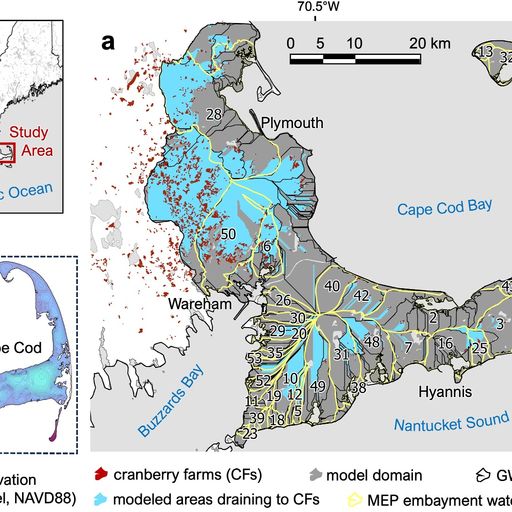
Modeling Nitrogen Load Reductions from Restoring Wetlands on Retired Cranberry Bogs
By
Adrian Wiegman
on September 26, 2025
(updated November 13, 2025)
I am please to share a new open access publication from our research team at US Department of Agriculture — Agricultural Research Service and Partners at Woodwell Climate Research Center and Buzzards Bay Coalition. The citation and access links and highlights are given below.

What are the water quality benefits of wetland restoration?
By
Casey Kennedy
on August 20, 2022
(updated October 4, 2022)
We answered this question using field measurements of nitrogen fluxes in groundwater and surface water at Tidmarsh. We found that Tidmarsh retained 28% of the nitrogen entering as surface water and groundwater. Although 28% nitrogen retention was low compared with natural wetlands, it will likely improve as vegetation and soils mature, which may increase residence times, enhance hydrologic connectivity, and facilitate favorable conditions for biogeochemical transformations the promote nitrogen retention.