Living Observatory Community Platform
Why it matters: Cranberry bogs that are retired provide an opportunity to protect and restore wetlands in Southeastern Massachusetts

Cranberry farms are built on wetlands. Estimates suggests that there are between 13,200 and 13,500 acres of productive bogs in Massachusetts. Eel River headwaters was the first cranberry farm to be restored. Plymouth 2010.
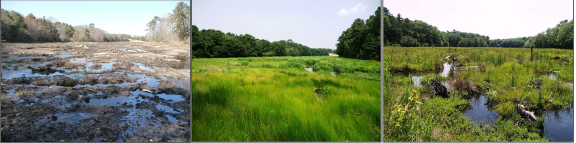
--Eel River at time 0, year 1, year 3 post-restoration -credit Alex Hackman
Wetlands provide ecological services including water storage during large scale weather events, carbon sequestration, denitrification, and natural space for public enjoyment. If farmland is not restored it will likely develop on a semi-upland trajectory.
Early soil studies (2015-21) by Professor Kate Ballantine, Mt Holyoke College and a LO member show that key desirable wetland variables (nitrogen removal and organic matter) develop far more rapidly on farmland that has been restored than on farmland left to re-wild on its own.
Insight: To improve wetland restoration methods, we need to learn from the properties that we are restoring.
Wetland restoration requires diverse expertise, as well as significant funding. In 2015 the Legislature formed the Massachusetts Cranberry Revitalization Task Force. The Final Report issued in 2016 included restoration as an appropriate action for farms where revitalization is not a good option.
Permanent easements funded by the USDA Natural Resources Conservation Services often provide a starting point. As of 2026, the Massachusetts Department of Fish and Game's Division of Ecological Restoration has supported 20 restoration projects. They have recently issued several new funding packages.
Town of Plymouth, Town of Falmouth, Mass Audubon, Buzzards Bay Coalition, Nantucket Conservation, Nantucket Conservation Foundation, Barnstable Clean Water Coalition, Wildlands Trust are a few of the municipal and land trust organizations who are actively involved in protecting and restoring cranberry farmland.
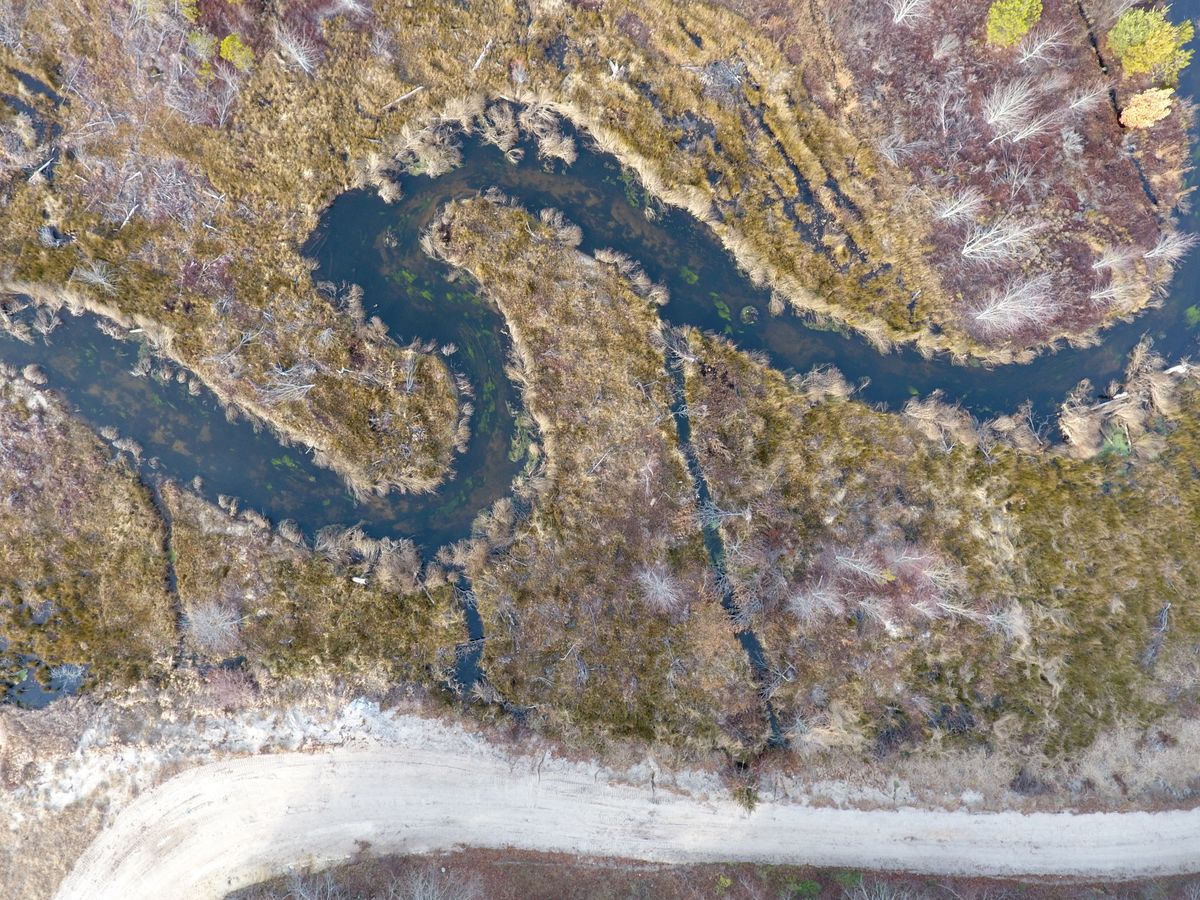
First drone images of a restoration, 2016 Eric Heller